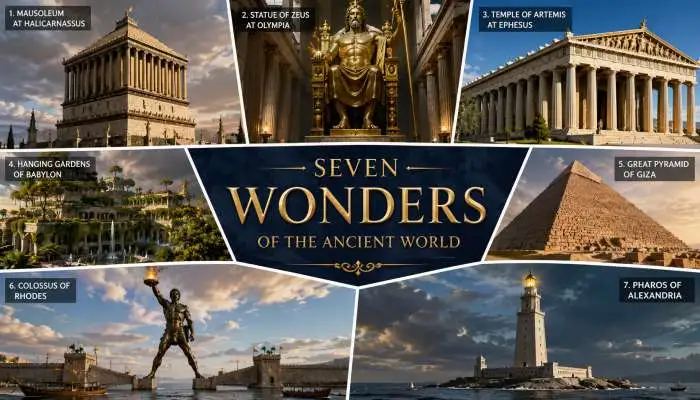
Imagine if you were a traveler way, way back in time. your bucket list would surely have been the Seven Wonders of the Ancient World. We're talking the Lighthouse of Alexandria and Hanging Gardens of Babylon and so many other Egyptian and Greek wonders that lasted for years - save for the Great Pyramid of Giza, the only one that stands today. But fret not, Budget Direct and NeoMam Studios reincarnate those ancient attractions as places we would visit if we traveled back in time.
The ruins: Temple of Artemis at Ephesus, Turkey
This temple well deserved its nickname, with the Roman author Pliny the Elder labelling it as 'The most wonderful monument of Grecian magnificence'. Builders constructed it during the 6th century BC in what is today Turkey on the western coast to honor Artemis, goddess of the hunt and the wilderness, and it stood 425ft (129m) long and 225ft (68m) wide. In fact, according to Pliny, it was nearly twice as big as the Parthenon in Athens!
You may also read :- 11 Amazing Attractions That Vanished Forever
The ruins: Lighthouse of Alexandria, Egypt
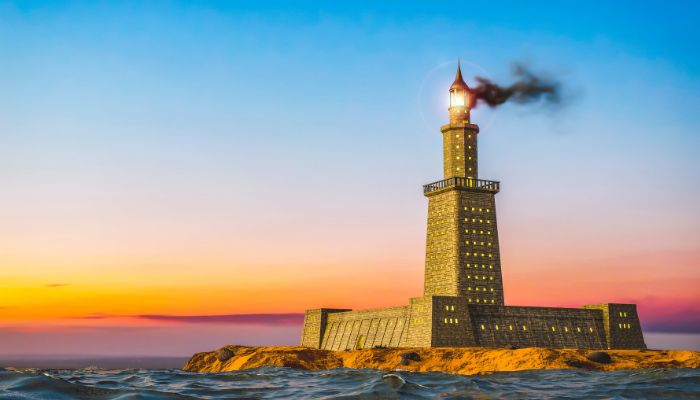
Of all the beacons in history, the Lighthouse of Alexandria, also called the Pharos of Alexandria, is likely the most well-known. This structure stands on the limestone islet of Pharos, and it serves to help ships find their way to the East and West harbors of the port of Alexandria. Completed around 280BC, at 300BC, people believed it to be over 360 feet (110m) tall, and thus one of the tallest structures to ever exist in ancient times.
The ruins: Hanging Gardens of Babylon, Iraq
Of the Seven Wonders of the World, none is quite so mysterious as the legendary Hanging Gardens of Babylon, which people said existed at the royal palace in ancient Babylon, south of the modern city of Baghdad in Iraq. People say Emperor Nebuchadnezzar II built them sometime between 605 BC and 561 BC to please his wife Amytis, who missed her Persian home and its green and lush surroundings; very little is actually known about them. Some even doubt if they ever existed at all!
The reconstruction: Hanging Gardens of Babylon, Iraq
Subsequent Greek and Roman authors imagined the Hanging Gardens as a stone structure in the form of an artificial mountain or ziggurat that was unheard of in the area. Plants, flowers and trees of all kinds flourished on its levels and flowed down its sides, thus giving it its name. Water to support this oasis in such an arid region could have come via a rudimentary irrigation system, using water from a well or the Euphrates River, and possibly even an ingenious pumping system.
The ruins: Great Pyramid of Giza, Egypt
As the oldest and only remaining original wonder of the world, the Great Pyramid of Giza (also known as the Pyramid of Khufu) demonstrates the impressive strength of Egypt's engineering capabilities. It stands as the biggest among the three main pyramids that are located on the west side of the Nile, close to the Giza Necropolis. Workers built this magnificent structure as a tomb for Pharaoh Khufu, and experts believe that it took approximately two decades to complete, utilizing around 20,000 workers in the process. Builders completed its construction sometime around 2570 B.C. The other two main pyramids belong to Khafre and Menkaure.
The ruins: Mausoleum at Halicarnassus, Turkey
The imposing mausoleum that builders constructed for Mausolus, ruler of Caria in southwestern Asia Minor (modern-day Bodrum, Turkey), from 353–350BC, testifies to its builder's genius. In fact, the enormous tomb's beauty and magnificence were such that Mausolus' name became the source of the term 'mausoleum'.
The ruins: Statue of Zeus at Olympia, Greece
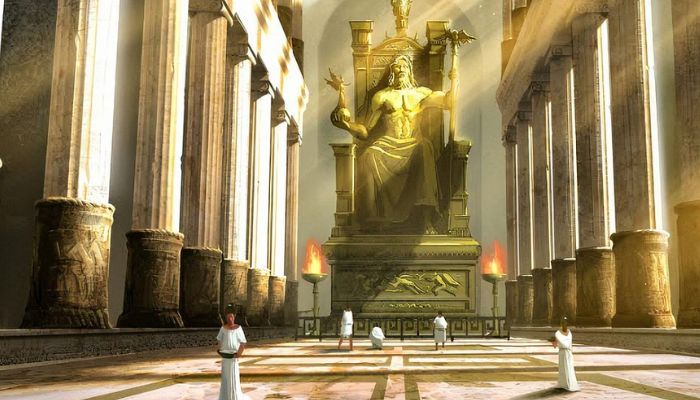
The celebrated Greek sculptor Phidias fashioned the 39ft (12m) gold-and-ivory-plated statue of Zeus in 436BC and it once resided in the Temple of Zeus at Olympia, western Greece. An exquisite work of art by the ancient Greeks, it made a profound impression upon Greek and Roman art - adorning pottery, coins and more.
The reconstruction: Statue of Zeus at Olympia, Greece
The statue itself was shown to depict Zeus sitting on a massive throne made of cedar wood, which was covered in gold, ivory, ebony, and gemstones. A staff, topped with an eagle, was held in his left hand, and a statuette of Nike, the Greek goddess of victory, was rested on his right arm.
Visitors from all over the ancient world were attracted to the temple, which was around for nearly a millennium before the disappearance of the statue. It is said by some that it was vanished when the Temple of Zeus was burned down in 426 CE. Other stories say that it was taken to Constantinople (present-day Istanbul), and then it was destroyed in a fire a few decades later.
Conclusion
The Great Pyramid of Giza is the only ancient wonder still standing. All the others were destroyed centuries ago, so we only know what they looked like from old writings, leftover ruins, and modern 3D models.
FAQ
Which ancient wonder can you still visit?
Just the Great Pyramid in Egypt. The rest were destroyed over time by fires or earthquakes.
Were the Hanging Gardens of Babylon real?
We aren't sure. Archaeologists haven't found any physical proof or ruins yet. Almost everything we know comes from stories written by ancient Greek and Roman writers.
Why do we call big tombs "mausoleums"?
It's named after King Mausolus from ancient Turkey. His tomb was so huge and detailed that people started using his name to describe any massive tomb.